

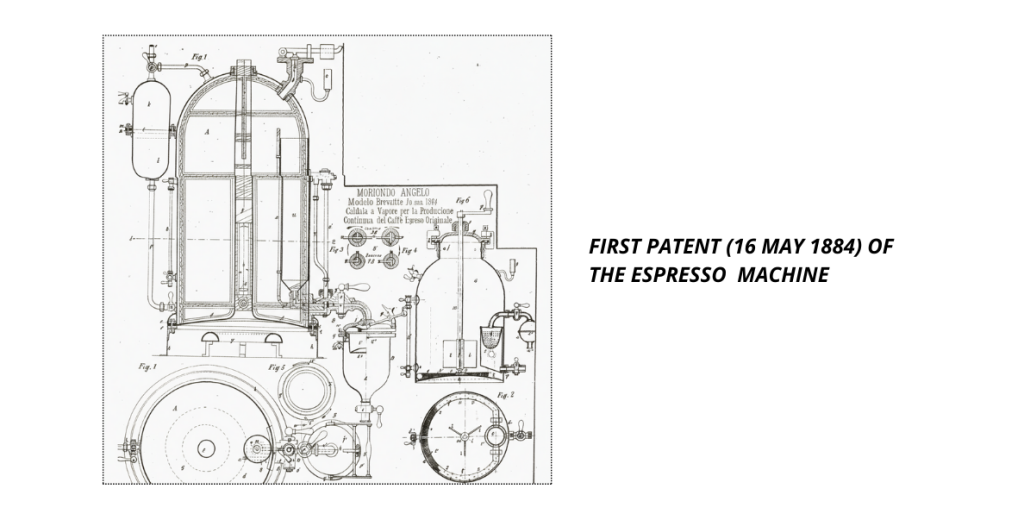
Angelo Moriondo: The Beginnings of Espresso
In the late 1880s, a man named Angelo Moriondo, the owner of a grand hotel and café in Turin, Italy, faced a problem: it took too long for his guests to receive their coffee after they placed their order. Percolation was the brewing method of this time, and in order to brew a cup of coffee, café owners would have to make an entire pot of coffee for one customer. Determined to serve coffee more quickly, he devised a machine that used steam to push hot water through half a kilo of ground coffee, resulting in what he called “caffe instantaneo.” While the machine succeeded in speeding up the coffee-making process, it fell short in producing true espresso. The coffee it made lacked the rich, creamy mouthfeel associated with espresso, resembling more of a filter coffee. Despite its limitations, Moriondo’s machine laid the foundation for future advancements in espresso technology. Recognized as the godfather of espresso machines, Moriondo was granted a patent for his invention on May 16, 1884.
La Pavoni Ideale: First Commercial Espresso Machine
The La Pavoni Ideale espresso machine was one of the first commercial espresso machines introduced in the early 20th century. La Pavoni was founded in 1905 by Desiderio Pavoni in a little workshop in Milan. His first invention was the filter holder, which brought about the first espresso coffee machine called “Ideale.” These ornate machines, resembling fire hydrants with proud metal eagle embellishments on top, found their way into hotels and bars across Italy. While they improved upon Moriondo’s coffee freshness issue with a porter filter for fresh coffee orders, they had significant flaws. The machines could be extremely dangerous, as they operated under high pressure, leading to potential explosions and accidents for the baristas. Apart from the safety concerns, the quality of coffee brewed by these early machines was far from satisfactory. The espresso made with super hot steam resulted in highly extracted, strong, and bitter coffee, more akin to Italian stove-top coffee than the creamy, luscious espressos we know today.
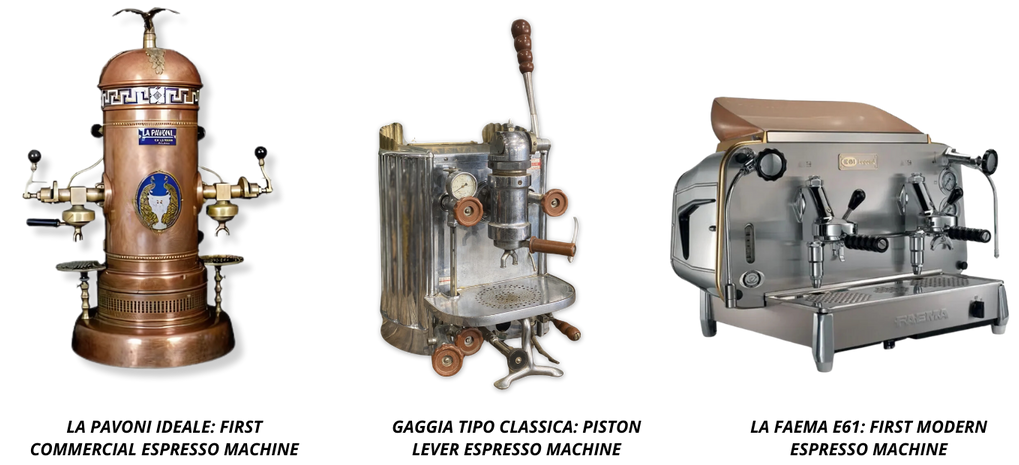
Gaggia Tipo Classica: Piston Lever Espresso Machine
After World War II, in 1947, Angelo Gaggia developed a method by utilizing a cylinder and a hand-operated lever to force water of proper temperature through the ground coffee. This had three benefits: it decreased the brewing temperature, improved quality, and simultaneously increased the pressure from the 1.5 atmospheres of steam to the 9 atmospheres still used today, and it produced the golden crema we have come to expect in a properly pulled shot. While the Gaggia Classico was a major improvement over earlier machines, it was not without flaws. Maintaining a consistent brewing temperature proved challenging, resulting in occasional sour-tasting shots. However, the most significant issue was the potential danger posed by the lever mechanism. Baristas had to be careful when operating the lever, as it could spring back violently if not clicked into place correctly. This led to unfortunate accidents and injuries!
La Faema E61: First Modern Espresso Machine
In 1961, the La Faema E61 espresso machine marked a significant advancement in espresso technology. It featured two major innovations: a pump that provided the necessary pressure for brewing and a heat exchanger that ensured consistent brewing temperatures. With the pump generating nine bars of pressure, the dangerous lever mechanism was no longer needed, making the process safer and more efficient. The heat exchanger allowed baristas to make multiple espressos without waiting for the boiler to refill and reach the right temperature, improving the overall espresso-making experience.